Writing
Why Didn't I Think of That?
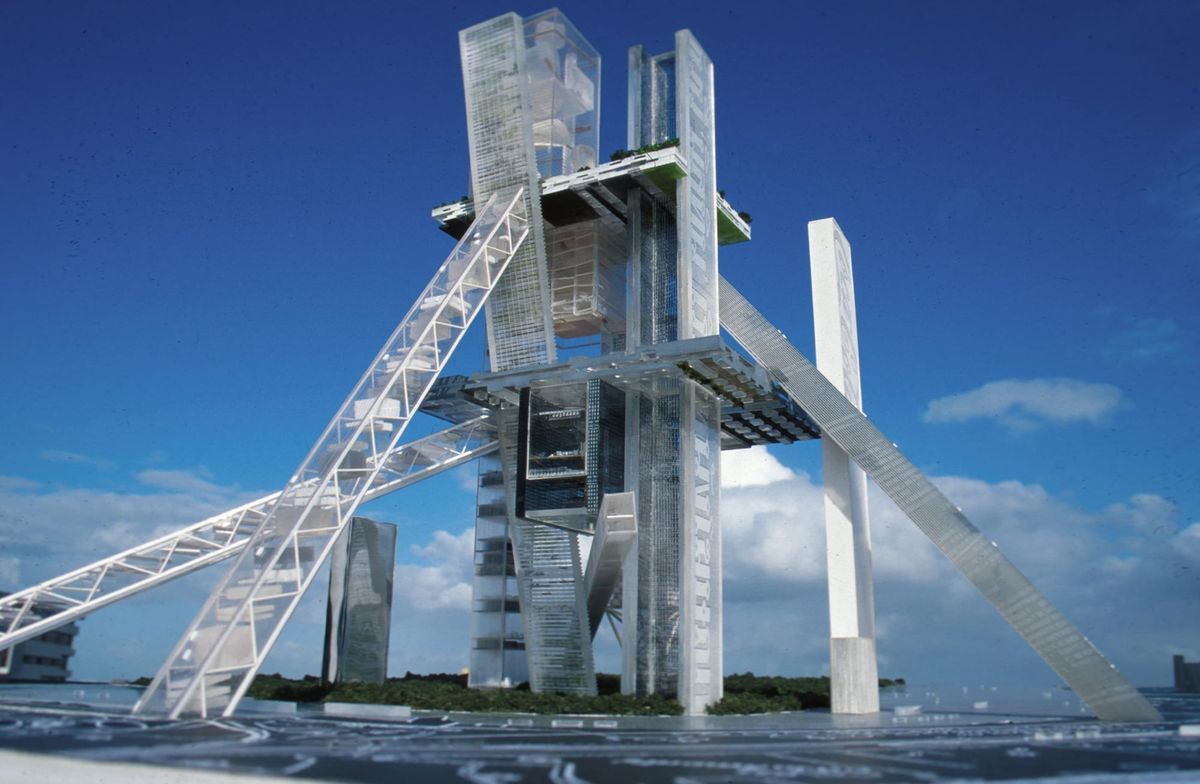
While conducting undergraduate thesis research on skyscrapers, I discovered OMA’s 1996 proposal for the Hyperbuilding in Bangkok. The project description succinctly outlines the architectural problem with striking clarity:
"The stability of ever-taller towers is bought at the expense of increasing their footprints, either in the traditional form of the pyramid, or as a larger and larger tube…To avoid the core of darkness inevitably present in very large pyramidal skyscrapers, we propose a mass of thin towers and blocks of program. Composite stability is achieved through an orchestration of mutual dependence."
Rem’s contrarian designs actively seek out trends in the architecture community and then subvert them with relentless rationality. When we zig, he zags. His unique combination of clever formal manipulation, problem-solving acumen, and a writing style that exudes an irrefutable logic explains the root of Rem’s undeniable influence. It also elicits a common reaction: Why didn’t I think of that?
His project catalog reveals many examples of manifestos made into reality. While Koolhaas admits that the Hyperbuilding’s form is an attempt to build a taller tower than ever before, he subsequently criticizes the very same banal ambitions illustrated in his own prior projects. The highly publicized CCTV headquarters in Beijing is described as “an alternative to the exhausted typology of the skyscraper” and actively avoids “competing in the race for ultimate height and style.” In this case, logic can only be superseded by more recent logic.
For the Casa da Música, Rem observes other architects’ exasperated attempts to reinvent the form of the traditional “shoebox” concert hall, and he instead focuses on the relationship between interior and exterior. Why try to put a square peg in a round hole? In addition, the Seattle Central Library, known primarily for its unorthodox shape and dia-grid facade, contains a ruthlessly logical “book spiral” that “never forces the ruptures within sections that bedevil traditional library plans,” and “can accommodate growth up to 1,450,000 books without adding more bookcases.”
Due to its extravagant cost and absurd height (over one thousand meters with towers spanning over the entire Chao Phraya River), the Hyperbuilding was never constructed. Nevertheless, the typology is experiencing a recent resurgence as many architects (mostly Rem’s protégés) have adopted a similar formal strategy. REX’s Museum Plaza in Louisville (2005), MVRDV’s Peruri 88 in Jakarta (2012), Bjarke Ingels’s # Cross Towers in Seoul (2012), and NBBJ’s Tencent headquarters in Shenzen (2013) all involve varying configurations of entangled vertical and horizontal structures. These projects also prove that if an idea is compelling enough, it doesn’t matter if someone else had thought of it before.
This essay was originally published in CLOG: Rem (2014).