Writing
Data-Space Invaders
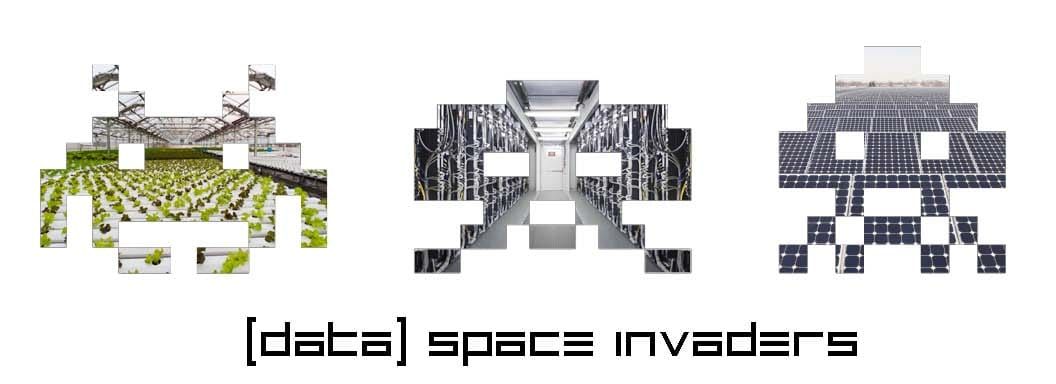
Data center design has been virtually ignored in traditional architectural discourse. Big-box warehouses full of servers but devoid of any discernible architectural features, data centers have thus far eluded critical scrutiny from the design community. They are essentially autonomous machines that not only don’t require architects to function, they hardly need any humans at all.
So where is the opportunity for creative expression? Architects and designers must now grapple with two compelling questions: what can the data center become, and, at a broader scale, how can humans interact more meaningfully with their essential infrastructures? Perhaps we can look to other typologies for inspiration.
The sustainability movement and the information age have spawned three nascent architectural entities: the urban farm, the solar farm, and the server farm. All three consist of small individual units that function most efficiently in large numbers, and therefore operate as economies of scale. Each typically performs with minimal human presence, and has historically been situated outside of the city, where land is cheap and space is plentiful.
However, as the population of cities around the world continues to grow larger, there is an increasing desire to incorporate food production and energy generation into the underlying structure of urban settlements. The Brooklyn Grange, already one of the world’s largest urban rooftop farms, is set to double its size when it expands into the Brooklyn Navy Yard. Exelon City Solar, the world’s largest urban solar farm, is currently generating up to ten megawatts of electricity in the south side of Chicago —enough to power 1,500 homes. The recently proposed “Zone Green” amendments to the NYC zoning resolution include provisions for additional rooftop farms and solar arrays, which suggest that it is only a matter of time before urbanized infrastructure becomes a mainstream phenomenon.
Could data centers be far behind? Food, energy, and data all seem poised for a massive invasion of urban contexts—one which will generate a unique opportunity for designers to explore how to creatively integrate data infrastructure with society.
Locating these typologies in formerly unfamiliar urban settings creates the potential for some exciting formal and programmatic scenarios. Can multiple rooftop farms be linked together to create an agriculturally productive version of the High Line? Is the excess heat generated by server farms used to keep residences warm in the winter? Will pre-packaged server modules be deployed across cities wherever their processing power is needed most?
Finally, what are the societal implications when cities grow so large that they turn in on themselves? Increasing the visibility of urban infrastructure is only the first step toward initiating a larger dialogue about its importance and meaning in our lives. Data centers represent our increasing ability to efficiently organize information, but now it is up to architects and designers to determine how that information will, in turn, organize us.
This essay was originally published in CLOG: Data Space (2012).